

When NDIS Reform Makes Support Feel Suspicious

Reform is not the problem. The story being used to sell it is.
What people are being taught to see
There is a way people are being taught to look at the NDIS right now, and it is getting louder. Sustainability, waste, rorting, blowouts, tightening things up. Underneath it all is the idea that disabled people getting support are part of the problem.
The things that should be setting off alarm bells are not getting the same attention: families burning through sleep, income, health, and whatever capacity they had left, while people get stuck between disability, health, housing, mental health, and crisis systems until they deteriorate, become unsafe, or die.
I am not saying that from one angle only. I have worked in this space, relied on systems like this, and cared inside them too.
I do not think that imbalance is accidental. That does not mean every person repeating it has bad intent. It means that version helps sell harder decisions. Fraud, rorts, blowouts, and "sustainability" keep attention on the worst examples, the cost, and the people supposedly taking too much.
They pull attention away from the harm people are already living.
I am not arguing there should be no scrutiny. Fraud, exploitation, and providers billing badly, overcharging, or causing harm should be dealt with properly. This is not about protecting providers from scrutiny. It is about making sure disabled people are not made to carry the cost of bad system design.
The Centrelink treatment
Once disabled people start getting seen as a cost problem before they are seen as people with support needs, everything shifts. Harsher decisions start sounding reasonable. Less explanation gets accepted. Suspicion starts sounding responsible. Help with ordinary life - getting out, staying safe, keeping routines, making decisions - starts feeling like something people should have to defend.
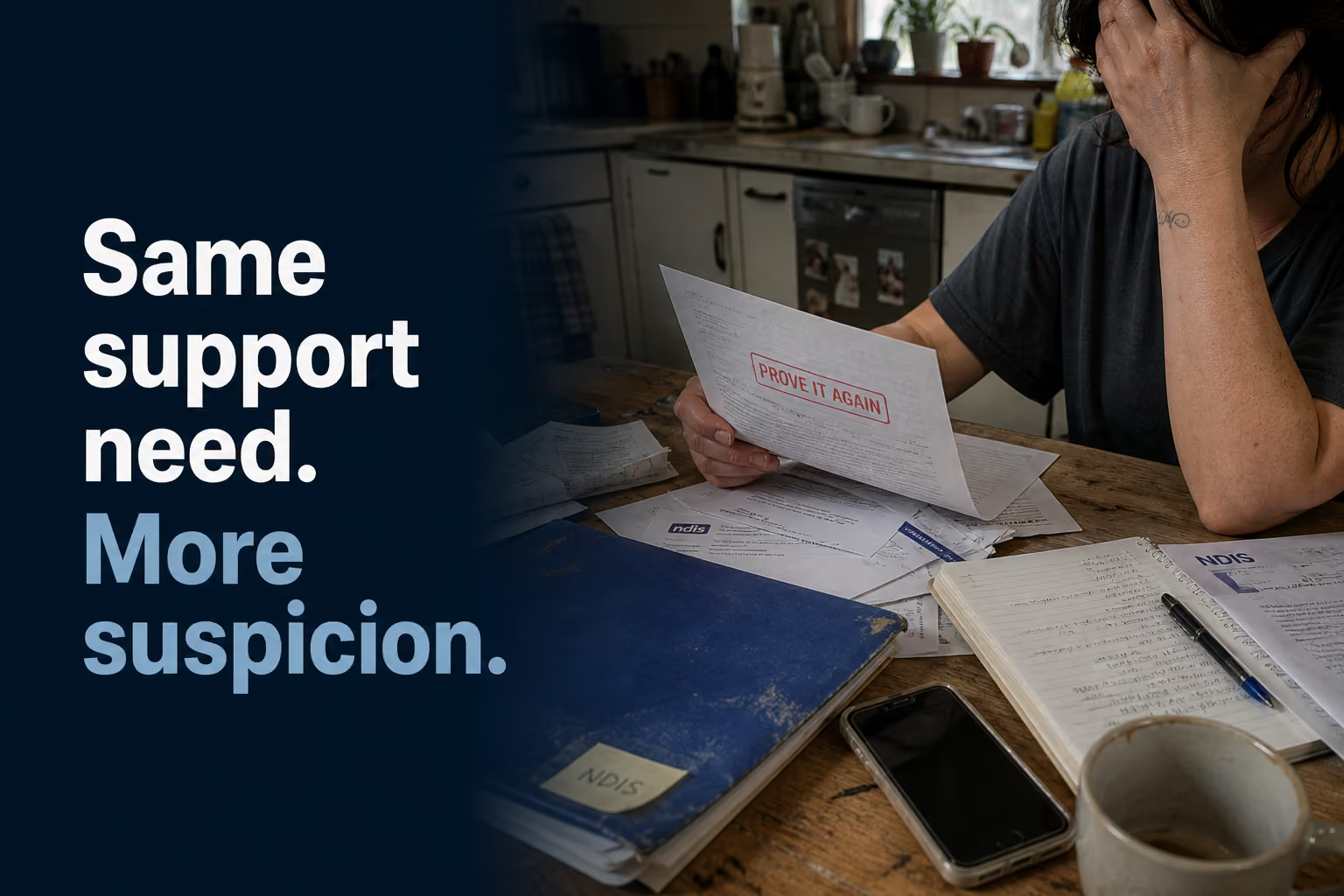
I keep joking that the NDIS is starting to get the Centrelink treatment, except it is not really a joke anymore. The systems are not exactly the same, but the suspicion feels familiar. That old "dole bludger" mood - who is costing taxpayers, who is taking too much, who really deserves help, who should have to prove it again - is starting to creep across.
That story works because it makes restriction sound like responsibility. Suspicion first. Support second. A quiet little "be grateful for what you get" sitting underneath it.
Disability support is getting pulled into the same old deserving-versus-rorting logic. Who is taking too much. Who is costing taxpayers. Who really needs help. Who should be tightened up. That kind of thinking does not stay in headlines. Once suspicion becomes normal, everyday support needs start getting treated like claims to be disproved.
Once support gets framed as excess, ordinary need starts looking suspicious.
Getting support is already a fight
There is this strange little idea underneath a lot of the current NDIS talk. That people are easily getting support. That the scheme has been too generous. That too many people have had too much for too long.
That is bullshit.
Getting approved for the NDIS is already a fight. People are not casually wandering into the scheme and walking out with gold-plated support packages. They are collecting reports, retelling private details, explaining functional impact, waiting, following up, being misunderstood, and trying to make very personal needs sound legible to a system that often wants clean categories.
The whole thing starts from a lie: that access is easy, support is generous, and people are getting more than they need.
Then when NDIS plans - the documents that set out what disability supports someone is funded for - are cut, or supports are narrowed, or people are told another system should pick things up, the person is left trying to prove the same need all over again. That is where people start getting smashed - not just emotionally, but practically.
Where people get left
People do not just "have less support" in some neat policy sense. They end up stuck between services. Disability says it is health. Health says it is disability. Housing says it is not their role. Mental health says the person is too complex. Everyone steps back until things escalate.
I have seen what that looks like. A lot of people in this work have. People deteriorate while everyone argues over whose job it is. Carers get smashed there too. A lot of the time, support coordinators and providers are trying to stop things from getting worse in the background.
People die in those gaps.
That is why the way people are talking about this bothers me so much. It keeps pulling attention back to misuse and cost, while the everyday collapse points stay boring, complicated, and easy to ignore.
What changed in practice
The legislation did not suddenly change overnight. The language did not either. Choice and control. Participant-centred planning. All the right words were still there.
But decisions started landing differently.
Planning conversations got shorter, less clear, and less useful. People were left guessing why supports changed. Some people found out what had changed after the plan had already landed.
At the same time, the media stories about fraud, rorting, waste, and crackdowns were getting louder.
The gap between the official language and what people were actually living got harder to ignore.
This is why the wording is not harmless. By the time reassessment and participant reduction are said plainly, people have already heard the same words for years: rorts, waste, blowouts, crackdowns.
The recent National Press Club speech and Q&A sharpened that concern, because reassessment stopped sounding like background admin and started sounding like reform direction.
Butler was asked whether every person under the NDIS would be reassessed to see whether they still qualify to stay in the NDIS. His answer was yes - over time. He said reassessment already exists, but that a new assessment tool is expected for 2028. First for new applicants, then for existing participants as plans are due to be replaced.
That does not mean everyone is being reassessed tomorrow. It does mean people already on the NDIS are included over time.
The government is also openly talking about moving from around 760,000 participants now to around 600,000 by the end of the decade.
People are not inventing the concern. They are responding to what has actually been said: tighter access, reassessment over time, and fewer participants by design.
And the same question is still sitting there: what is actually there to catch people if the NDIS steps back?
Bad process creates its own waste
People are not always getting proper planning conversations. They are not always told clearly what is being reduced, removed, or changed. Supports can disappear without being properly discussed, and the participant is left trying to work out what happened after the plan has already landed.
The law is not just paperwork. People are meant to know what is being decided about their supports, why it is being decided, and what they can do if the decision is wrong. That is not some fancy legal extra. That is basic fairness.
There has not been a clean transition. No clear reset. No honest acknowledgement of how inconsistent things were before. Instead, what people have felt is more refusals, narrower wording, less room to explain real life, and pressure to fix the problem after the decision is already made.
Then everyone else gets left cleaning it up: complaints, reviews, escalations, tribunal matters, more reports, more meetings, more stress, more time. Everyone pays for that somewhere.
A change of circumstances means someone asks the NDIA - the agency that runs the NDIS - to look at their plan again because something important has changed. External review means the person has had to go outside the NDIA decision process to have the decision looked at properly. None of that labour is free, and it does not disappear just because it sits outside the headline budget.
Support does not disappear when it gets blocked. It goes somewhere.
It shifts back onto participants, families, carers, coordinators, providers, unpaid labour, hospitals, housing services, police, emergency mental health, and exhausted households.
That is what sits underneath the budget line people argue about.
Why people keep pushing
When people have to go outside the NDIA into external review or tribunal, it usually means something has already gone wrong earlier. The planning process did not resolve it. The reasons were not clear enough. The evidence was not weighed properly. Or the person was left with a decision that does not match what they actually need.
That should not be the pathway people have to use just to get reasons, evidence, and basic fairness taken seriously.
External review is meant to be a safeguard, not the main way people get the NDIA to apply its own rules properly. But for a lot of participants and families, it is still where decisions finally get tested with evidence, reasons, and accountability.
That is why people keep pushing. Not because they have endless energy for it. Not because they want to fight the system for sport. Because sometimes it is the only pathway left when the decision does not line up with the person's disability-related support needs.
The legislation still counts. Review rights still exist. External review is still one of the few places decisions can be properly tested. But needing to use those rights should not be treated as proof the system is working.
It is often proof something failed before that point.
Where this leaves people
People are already living this. Not as a policy debate, but as delayed supports, confused decisions, exhausted families, and services backing away from each other.
I do not think giving up is the answer. Not because people owe the system more fight - they do not - but because pushing back is still where things can shift. I just hope people have someone beside them who knows the system and does not disappear.
A harsher system can sound sensible when the public has been taught to see need as excess. Reform should fix poor process, fraud, and gaps without teaching the public to distrust disabled people.
People should not have to go quiet just because the system has worn them down.
If you want the timeline
For anyone who wants the timeline, this did not come from nowhere.
The way the NDIS was talked about shifted in stages.
2021 - Independent assessments and the first big warning sign
Independent assessments were being pushed as fairer and more consistent. A lot of disabled people, families, advocates, and providers heard something else underneath it: less trust in existing evidence, less weight given to the people who knew the participant, and more room for standardised decisions to cut across real life.
The fear was cost control dressed up as consistency.
Source: ABC News, 9 July 2021 - www.abc.net.au/news/2021-07-09/ndis-disability-independent-assessments-model-dead-after-meeting/100277324
2021 - Selling the reform became part of the reform
Reporting at the time showed message-testing around how to communicate controversial changes. Governments test messages. That is not automatically scandalous. But it does show the public story was being treated as part of the reform work.
Source: The Guardian, 16 April 2021 - www.theguardian.com/australia-news/2021/apr/17/ndia-hired-research-company-to-sell-controversial-changes-to-staff-and-public-leaks-reveal
Late 2022 - Repair with hope
The NDIS Review was launched around trust, participant experience, and putting people with disability back at the centre.
2023 - Sustainability moves to the front
National Cabinet agreed to an 8% growth target. Media coverage started linking reform with cost pressure, savings, and possible cuts.
Source: NDIS media release, 26 April 2023 - www.ndis.gov.au/news/9087-media-release-minister-national-cabinet-commits-sustainable-ndis
Late 2023-2024 - Integrity and tightening
Fraud, overcharging, provider misuse, support lists, funding periods, and "original intent" became much louder.
Real provider issues started sitting beside tighter rules.
2025 - Redirecting people elsewhere
Foundational supports - disability supports promised outside the NDIS - and Thriving Kids were positioned as the answer for people who may not enter, or may later move out of, the scheme.
April 2026 - The harder direction gets said plainly
Functional assessments, reassessment over time, fewer projected participants, reduced growth, and tighter systems were put more clearly.
Source: Minister Butler, National Press Club speech, 22 April 2026 - www.health.gov.au/ministers/the-hon-mark-butler-mp/media/minister-butler-speech-at-the-national-press-club-22-april-2026
It was not one clean switch.
It was a slow shift in what got louder, what got normalised, and what kept getting pushed to the side.
Co-Founder | Practice Lead | NDIS Systems, Recovery & Lived Experience - Heart Worx
Jess Schafer-Wilson